Showing posts with label lyme treatment protocol. Show all posts

Friday, August 3, 2012

At the Core

So far we've explored how treatment effectiveness, our enthusiasm for our treatments and what people have tried. Today, we look at a different angle on treatment options: what do people currently consider to be the core of their protocols.

This is different from what we were looking at in the last couple blogs because it is less about what we've tried out and more about what we are relying on, based on whatever level of experience we (and our doctors) bring to this.

We'll also look at a couple of the specific protocols we surveyed about to see how those are working for people.


Here's the data from the survey:
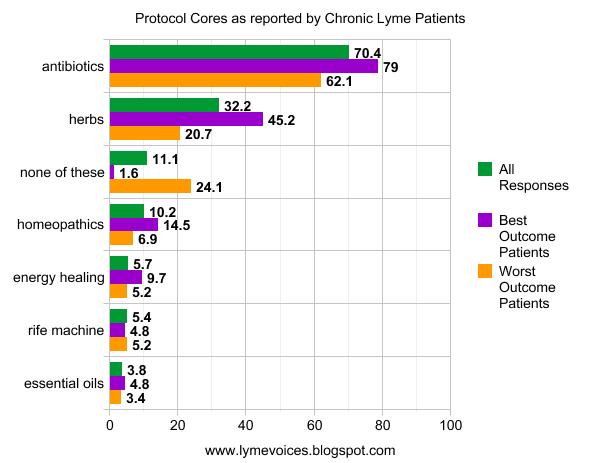

Now, I could spin these results in a myriad of ways. Here's a few:
  • People who try more things get better at a higher rate (I spun one of my other blogs in just that way, remember? See how the purple line pokes out further on most things?) In other words, integrative medicine is the way to go, and the more angles you hit lyme from, the better off you'll be.
  • People who get well are the ones for whom either antibiotics and/or herbs work well. (Given that there is lots of purple on both of those.)
  • Given that the best outcome patients only rarely ventured outside this list of 6 things as their cores, if you are going to get well, you'll probably find it here. (This analysis is especially suspect: just because I surveyed about them doesn't mean they are all that special. If I'd asked, say, about hyperbaric chambers, they'd probably have a similar response to some of the stuff here.)
  • In general, you are fortunate if you have access to antibiotics (a doctor who will prescribe them) and they work for you. Almost 80% of people doing well have them as a core, while only 62% of the worst outcome people do.
  • The biggest gap between worst and best outcome patients is in the use of herbs. Therefore, herbs must be a key thing for getting well.

(Side note: see how much fun it is, playing with statistics? I could write a whole blog on how tempting it has been to spin data to fit my own preconceived notions biases. As a general media literacy rule, always be wary of how people spin data! Look at the graphs closely and see if you see a different interpretation.)

Unfortunately, I have no way of knowing which of those spins is actually true; or perhaps a better way to say it is that each of those spins is probably true for some people and not true for others.

I do find it interesting, though, that antibiotics are only core for about 70% of us. I regularly hear people on our support lists express surprise that there are non-antibiotic options out there, or that people are trying anything else. And here's some concrete numbers to say, yes there are other options, and not everyone is primarily focused on antibiotics as their core... in fact a significant minority are looking elsewhere for healing, a chunk of whom are doing really well.

Beyond that, this is one of those blogs where I invite you to pick your own spin. You've seen a LOT of data from me, and probably have looked at other people's as well. What do you think is going on?

+++++++

Now, I worried a little bit that there might be a built in problem here that related to time. We all know that chronic lyme cases don't resolve overnight, and it seems like the first thing that almost everyone tries is antibiotics. We also know that a lot of folks in this survey are relatively new to the treatment game (just over half of the people in this pool have been treating for 2 years of less).

So maybe people are doing best with higher doses of antibiotics just because they are on them longer? Or maybe people give up on certain protocols, or we put faith in different things depending on the time we've been in treatment?

(I actually fully expected that second thing to be true, that we'd see a drift away from antibiotics and toward more alternative things as people decided the first thing their doctors tried wasn't going to work for them. There's those biases rearing their ugly heads, eh?)

So I ran these numbers about treatments for longer and shorter term patients, and here's what that looks like:


If you can see something here you'd call statistically significant, I'll eat my hat. When you take into account that the sample sizes for rife machines and essential oils are pretty small, I don't see any significant differences here at all. So the differences we see in core protocols don't appear to be because people tend to gravitate toward one end of the antibiotics-alternatives spectrum over time.

+++++

I also wondered if the variations were more about who we see (or don't) than anything else. Here's the breakdown, based on what type of practitioner support we have:


Now this is interesting! Here we do see significant differences (and in the next blog we'll look at lyme treatment success rates among different types of practitioners). The bottom line is that MD's are far more reliant on antibiotics as the core for treatment than ND's and OD's.

And people who are either essentially self-treating or relying on less knowledgeable doctors (which in some cases is functionally the same thing) are more likely to try a variety of options. This is probably in part because most non-LL practitioners won't prescribe antibiotics for the long term, and so they are forced into looking at other things.

However, some people are in this category voluntarily; they are choosing (either based on philosophy or giving up on professionals) to do it alone, in spite of the fact that it reduces their treatment options by eliminating access to long term (or any) prescription drugs.

Most interesting, perhaps, is how many therapies have a high enthusiasm rating (see my "Healing with an Open Mind" blog) and are not being used by lyme literate doctors, and especially MD's. This isn't that surprising  because MD's (like every other group of humans in the world) tend to rely on what they know, and antibiotics are one of their primary tools in their practices in general.

This information can be particularly helpful if you are in the process of choosing a lyme literate practitioner (and are either fortunate enough to live somewhere that gives you options, or are going to have to travel no matter what). Considering what your own preferred approach would be to healing, it is a good idea to choose a practitioner who is going to support hat basic mode.

As a very general statement, here's what I mean. Fan of antibiotics? Look for an MD. Interested in herbs and other alternatives? Look to the DO and ND doctors for that. Of course, you always want to ask about how that specific doctor approaches it, and these are generalities. Still, they look pretty significant to me, and knowledge, as they say, is power.

+++++

OK, I want to go down a side street before we close today. I had asked survey questions about two particular protocols (and of course since starting this process a couple months ago, have come into awareness about many others I could have asked about... next time!)

I had meant to include this with the last blog, but spaced it out. (You know how that goes). Here's the info about those two protocols.


 I've included the info about antibiotics and herbals next to these specific protocols because these are basically subsets of the larger categories: Marshall uses antibiotics as the main bug killer (in conjunction with other things) and Cowden is an herbal protocol.

It looks like both protocols perform as well as their larger categories, but they don't generate more enthusiasm. It isn't surprising to see them tried less, as there are any number of variations on the theme of antibiotic and herbal protocols.

I don't think this reflects the same kind of belief biases I was discussing in the last blog so much as there being a plethora of choices within each other larger categories.


Tuesday, July 17, 2012

Playing Co-Infection Roulette

You're familiar with Russian Roulette? The game where you put one bullet into an old-style gun, spin the barrel and shoot yourself? It's the ultimate playing of the odds... you only have a 1 in 6 chance of dying, right? And boy, what a rush. Never quite understood it myself, but I've always been a bit of a nervous Nelly when it comes to my physical body. Plenty of excitement in the world without courting danger, ya know?

I've always been more of a nature girl myself. I like the calm of sleeping next to a river, the sounds of nature and soft winds lulling me to sleep and gently tugging me awake in the morning. I love fresh air and feel spiritually fed by being in the natural world. Of course, what we are realizing now is that I've been playing my own version of Russian Roulette the whole time. All those hikes, camping trips, canoe trips, living in a tent for some festival or another... heck, just walking down the street, enjoying a closer connection with the natural world than I can get from my living room perch. "That tick? May be nothing. Or may be it's fully loaded... you just have to take your chances."

Most of us who have lyme managed to get the combination pack... it seems like hardly anyone has lyme only. And that makes treatment much more complicated. Here's what we are dealing with:


About 3/4 of us have Bartonella, and 2/3 Babesia. This charming couple (let's call 'em Bart and Babs) have some symptoms that overlap with lyme, and some of their own unique horrors. Bart makes neurological symptoms worse, and can be accompanied by a streaky rash that looks a little like out of control stretch marks. It also contributes to the general fatigue and headaches. Bart lives inside your cells and (partly because of that) can be hard to pin down on a blood test. One strain of Bart causes cat scratch fever, and it is known to be carried by human body lice across the globe. (See isn't this fun-- you can get lyme from one bug and then a bunch of other stuff from other bugs and just sort collect them over time, accumulating health issues as you go along.)

Babs is often the culprit if you think you are having a heart attack of entering early menopause (or if you are a guy with menopause-like symptoms, such as hot flashes and night sweats.) If you have the quite literally named "air hunger" or have chest pains, it might be Babs. Babs is a parasite and is treated similarly to malaria.

For a much more thorough look at co-infection symptoms (and a longer list of the possibilities) I recommend downloading the excellent "Lyme & Co Symptoms Checklist" on the Living Lyme site (scroll down the right hand side on this page until you reach the downloads).

There's also a quicker intro to 5 co-infections here. While I take issue with the idea that lyme is "easily diagnosed" (see my last few blogs) this is a sound basic intro that you can share with folks who might want more information and don't have the patience to wade through the more thorough checklist.

Because lyme rarely flies solo in our systems but usually has all these friends along, I like the term "Multiple Chronic Illness Disease Syndrome" rather than simply chronic lyme.

++++++

We will next be looking at symptoms, and then move into the treatment section of the survey. But for now, I'm offering a little treatment foreshadowing. Why is treatment so complicated with lyme, and what do the co-infections add to that mix?

Lyme would be much more simple to deal with if it were an "ordinary" bacteria however, spirochytes are more complex than most and some scientists actually think they should be in their own category.

Lyme can exist in 3 forms, and it is skilled at choosing the best tactic for survival at any given time. The spirochyte form is the great traveler: its unique shape lets it burrow into tissues and take up residence in almost any system in the host body. When threatened, though, it can turn very quickly into a "cyst" form, which is the hiding out form. One of the main reasons why a quick dose of antibiotics won't cure a lot of us is that the clever little devils go cyst-form on us and just wait it out. The antibiotics given for spirochytes don't touch the cyst form. The third form is a specialized form of bacteria called a "cell wall deficient" bacteria. Many antibiotics work by destroying the cell walls, which for an ordinary bacteria is the end of the story. However, no cell wall means there needs to be a different approach to killing them.

So now we are up to needing three types of treatment just to handle the lyme bug itself.

Lyme has two other tactics to keep alive. One is that they can ball into clumps, essentially protecting the inner layers from whatever treatment you are throwing at it. This doesn't mean new methods are needed, but it does add more time to the treatment. (They also have a very long reproductive cycle-- 4-6 weeks; most bacteria's life cycles are measured in hours. This also means longer treatment times are needed to wipe them out.) And finally, a lot of bacteria (including lyme) produce gelatinous goo in your bloodstream called "biofilm". This gives the bacteria a safe haven protected from treatment and also can make your blood sluggish, reducing the amount of oxygen your organs are getting. While the jury seems to still be out on how important biofilms are to address, many lyme literate doctors suggest taking a remedy to help get rid of them.

See how they are a lot harder to kill than ordinary bacteria? And this doesn't even take into account switching up medicines to avoid creating superbugs resistant to antibiotics. And... we haven't even gotten to the co-infections.

Let's just take Bart and Babs. Bart, luckily, is also a bacteria, so the methodology for killing Bart is not so different from killing lyme. While you may want different antibiotics or herbal antimicrobials to address the two things, they are at least not requiring a new category of remedies. Babs, however, is a parasite.

There are several big categories of bugs that can make you sick: bacteria, parasites and viruses are chief among them. And they are all treated differently. On top of co-infections, many of us find ourselves with old illnesses re-triggered. How that works is that you may, like me, have had mono (Epstein Barre Virus) when you were 19, and the virus has essentially been held in check by your immune system since then. Now, however, as your immune system becomes weakened, the EBV reasserts itself and now must be dealt with as yet another infective layer in your system. Part of how MCIDS patients end up taking 10, 20, 30 pills or liquids a day is that we have our own particular soup we are dealing with.


For lyme alone, you may find yourself taking:

1-10 pathogen killers: pharmaceutical antibiotics, herbal antimicrobials, rife machines, etc.
probiotics to counteract the negative affects of your main treatment
an additional "cyst buster"
biofilm reduction
vitamins for general immune support and to replace what the lyme is pulling from your system
medication to help sleep
medication for pain management
medication for energy support
medication to manage other symptoms (such as depression and neurological issues)

Let's assume, for simplicity's sake, that your Bart treatment is included. Now add several remedies each for the parasites and viruses you are also dealing with.

Here's the protocol I've been on for my diagnosis for the past 6 months (with links for the specific products I'm using as resources). This combo is designed to treat Lyme, Bart, Babs and Epstein Barre Virus.

600 mg/day (in two doses) oral doxycycline: for spirochytes
grapefruit seed extract w/ oregano oil: for cyst busting and antimicrobial
3 kinds of probiotics, rotated
lumbrokinase: for biofilms
multivitamin for general immune support
vitamin D3 drops (lyme uses up vitamin D and can leave you horribly deficient)
lauricidin: for bacteria and viruses
garlic tincture: for bacteria, viruses and parasites (mine is homemade)
slippery elm: for helping my tummy deal with the garlic and doxy
MRibose: for energy regulation
clay cleanse: for detoxing and heavy metals removal
ibuprofen as needed: for pain management
Night Rest herbal and mineral formula: for insomnia
rife machine sessions rotating between the 4 diagnoses and kidney/liver support
massage twice a month: for lymph drainage and pain management
detox baths a couple times a week and drinking lemon water as needed for further detox

Lest you think this is crazy complicated, my protocol is simple compared to a lot of peoples, and probably considered "not aggressive" enough by some since I'm only taking one pharmaceutical antibiotic. I'm in the process of switching over to a protocol based on Dr. Buhner's Healing Lyme book, focusing on his recommended herbs, the rife machine and an infrared sauna.

We'll talk more about treatments in a week or so. Next we turn our attention to symptoms and the impact lyme is having on our lives.